

A lot is happening in Europe right now when it comes to digital identity, eSigning and digital trust.
And yes, I know that the sentence “Hey … ETSI has started a new work item on eIDAS standardisation” does not exactly sound like something you would shout about in town on a Friday night. But it is something you can think about while doing a bit of autumn tidying in the garden on a Saturday afternoon.
Because if you work with digital signing or are responsible for it in your organisation, it is actually worth keeping an eye on. Especially if you want to understand where we are heading.
That is what I will try to explain here, in a way that everyone can understand.
What is happening now is about more than the digital signature itself
ETSI (European Telecommunications Standards Institute) has started work on updating the European framework for standardisation around eIDAS (electronic Identification, Authentication and Trust Services), digital identities and trust services.
The specific work involves updating TR 119 000 with new standards, including standards supporting the EU Digital Identity Wallet.
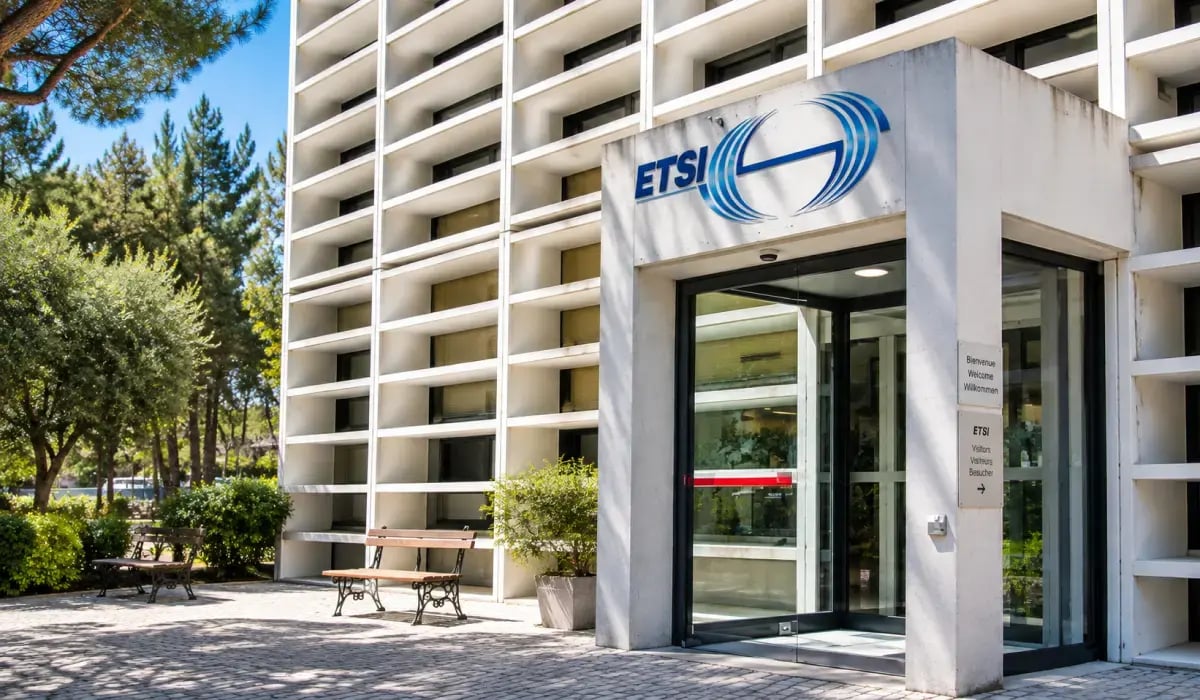
ETSI’s headquarters in Sophia Antipolis, France. This is where the European standards that help shape the future of digital identity, electronic signatures and digital trust services are developed. ETSI is located on Route des Lucioles in Valbonne, in the heart of the Sophia Antipolis technology area on the Côte d’Azur.
The work was formally adopted on 8 September 2026 and will, among other things, update the existing standardisation framework with new standards, including standards supporting the EU Digital Identity Wallet.
It sounds nerdy and technical. And it is. But the basic idea is actually quite easy to understand.
A digital signature should not stand alone.
When you sign a contract with MitID, it is of course important that we can document who signed it. But in many situations, that is not enough.
Imagine, for example, that your company is entering into an agreement with a new supplier. You do not just want to know that Peter Hansen has signed.
You also want to know:
- That Peter Hansen is actually who he says he is.
- That Peter Hansen works for the company he says he works for.
- That Peter Hansen had the necessary role at the time.
- That Peter Hansen had the right to enter into the agreement.
- That the information about the company is correct.
- That the document has not been changed.
- And that you can still document all of this five or twenty years from now.
All of this, regardless of which EU country Peter and his company come from.
This is precisely where digital trust becomes interesting.
We can already sign digitally across borders
Digital signing already exists. So it is important not to make the development more dramatic than it is. We do not have to wait for a new European standard to be able to sign across national borders.
We can already do that.
In Addo Sign, for example, a Danish signer can sign with MitID, while a Swedish signer signs the same contract with BankID.
It works. And it works really well.
The new development is not about making the signature itself possible. It is about making the entire digital transaction more connected and verifiable.
And that is much more interesting.
From “sign here” to “can we trust what we are signing?”
The EU’s work on the EUDI Wallet is moving in that direction.
The wallet is intended to support digital identification, verified information and digital signatures. The idea is that you should not only be able to prove who you are, but also share verified information about yourself securely.
This could, for example, include information about your age, address, education, licences or other attributes.
That opens up some pretty interesting scenarios.
Imagine that you are renting a home.
Instead of sending a pile of documents, copies of ID, payslips and various PDFs back and forth, you can imagine a future where you give the landlord access to the specific information that is necessary – and only that information.
Or consider an employee who needs to sign an agreement on behalf of their company.
In that situation, it is not only interesting to know who the employee is, but also whether they can prove their role and their right to act on behalf of the company.
These are the kinds of digital transactions that the EU is quietly building the foundations for.
To make this a little more concrete, you can think of the EUDI Wallet as an ecosystem of different services and technical components:
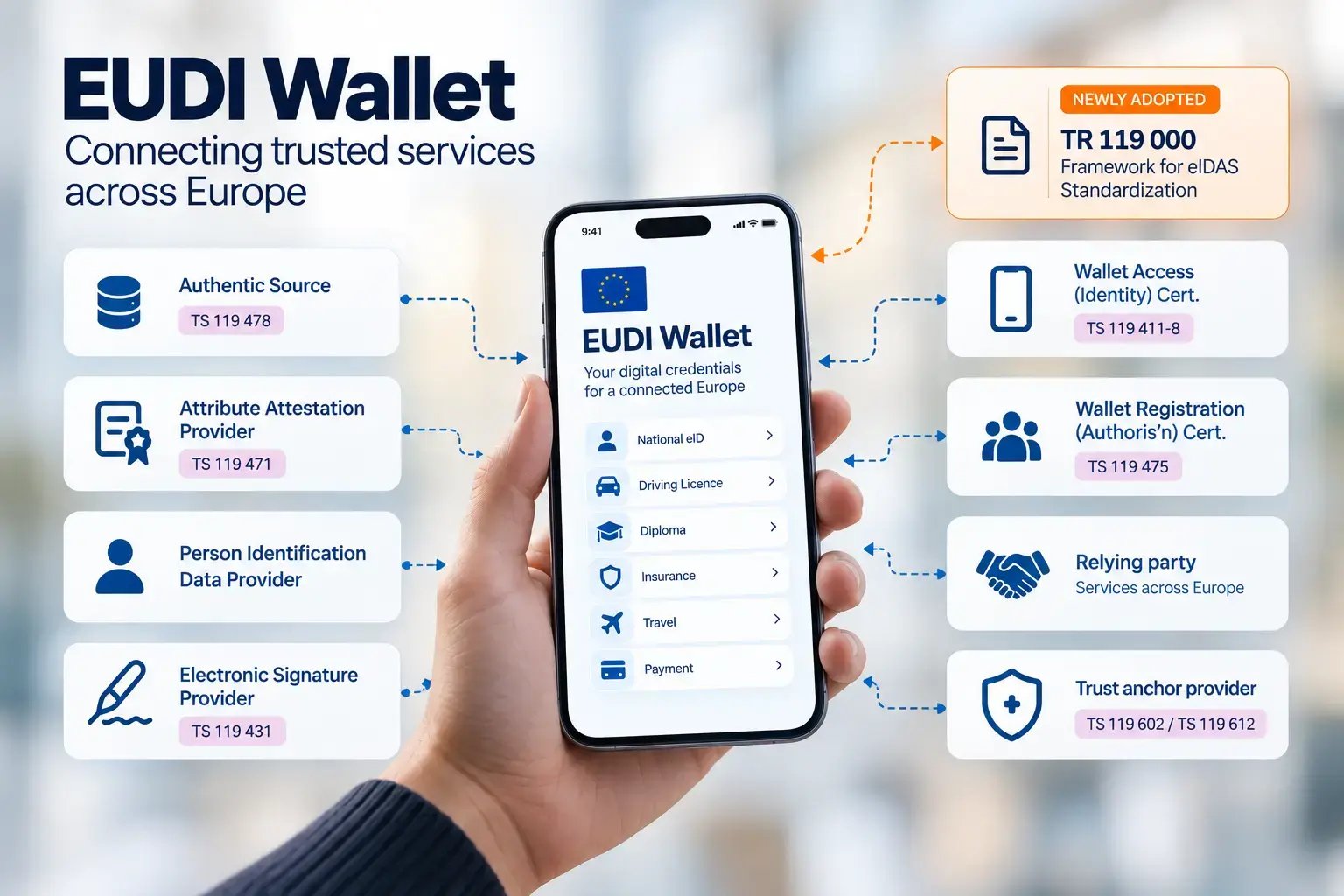
The future vision for the EUDI Wallet. The illustration shows some of the services and technical components that will help make European digital identity work in practice, from identification and verified information to digital signatures and trust services. The TS numbers in the illustration refer to Technical Specifications developed by ETSI (European Telecommunications Standards Institute), which describe the technical requirements and standards behind the solution. The app shown is an illustration and is not an official representation of a finished EUDI Wallet. Image created with AI.
What does all this mean for your organisation?
This is where I think it is important to keep both feet on the ground.
You do not need to panic.
ETSI’s work does not mean that you need to replace your eSigning system on Monday. But it is a good time to ask some better questions about the solution you are already using.
- Can it handle different eIDs?
- Can it work across borders?
- How are signatures validated?
- How is the entire transaction documented?
- How are documentation and evidence handled over the long term?
And perhaps most importantly:
How is your provider preparing for the development of the EUDI Wallet and the new European standards?
For me, that last question may be the most important one. You do not need to know exactly what Europe’s digital infrastructure will look like in 2028.
But you should choose solutions that can evolve with it, and with the needs of your organisation.
It is not all happening on one particular day
One of the things I find interesting about this development is that there will not be one particular date when “the future of digital trust is launched”. The work is already underway, and things are happening gradually.
eIDAS and European trust services are already a reality. EUDI Wallets are on their way, and Member States are required to make at least one wallet available by the end of 2026. At the same time, ETSI is continuing to work on the technical standards that will help bring the different pieces together.
The European Business Wallet is another example. Here, the EU is still working through the legislative process, but the ambition is, among other things, for businesses to be able to identify themselves, share verified documents, sign and delegate rights digitally.
So it is all coming together little by little.
When you have followed digital development for many years
When I look at all of this, I cannot help thinking about how far we have actually come. A number of years ago, I worked as a UX consultant defining requirements and writing tender material for MitID together with other great people at the Danish Agency for Digital Government.
Back then, the focus was very much on creating a common digital identity. Today, we are talking about something much bigger. Identity. Rights. Attributes. Documents. Signatures. Validation. Secure delivery. Digital wallets.
And this is not just happening within one country. It is happening across Europe.
It is quite a remarkable development to have followed.
And perhaps that is also why I think it is worth keeping an eye on those slightly dry EU standards, even when they arrive wrapped in acronyms, work items and documents running into hundreds of pages.
Because ultimately, this will have an impact on both your and my everyday lives, and on how we design and operate digital services in our organisations. And of course, it is also an important development for Addo, where I work.
Follow me on LinkedIn and I will keep you updated on the development (see link below).
Next steps at ETSI
- 8 September 2026 – ETSI adopts the work to update TR 119 000 and the European framework for eIDAS standardisation.
- 27 September 2026 – The specific standardisation work is expected to begin.
- January 2027 – An initial stable version of the updated report is expected to be ready for further processing.
- 4 April 2027 – ETSI expects to publish the updated TR 119 000.
Planned dates may of course change along the way.
Links and sources
- ETSI: TR 119 000 – Framework for eIDAS Standardization
- ETSI: Standards make Digital Wallets work for 450 million Europeans
- ETSI ESI – Electronic Signatures and Trust Infrastructures
- European Commission: European Digital Identity
- European Commission: EUDI Wallet implementation
- European Commission: Trust services
- Council of the EU: European Business Wallets